Income Tax Notice Received? 7 Things You Should Check Before Replying
An income tax notice isn't automatically a penalty — but replying wrong can turn a routine mismatch into a bigger problem. Here are the 7 things to check before you respond.
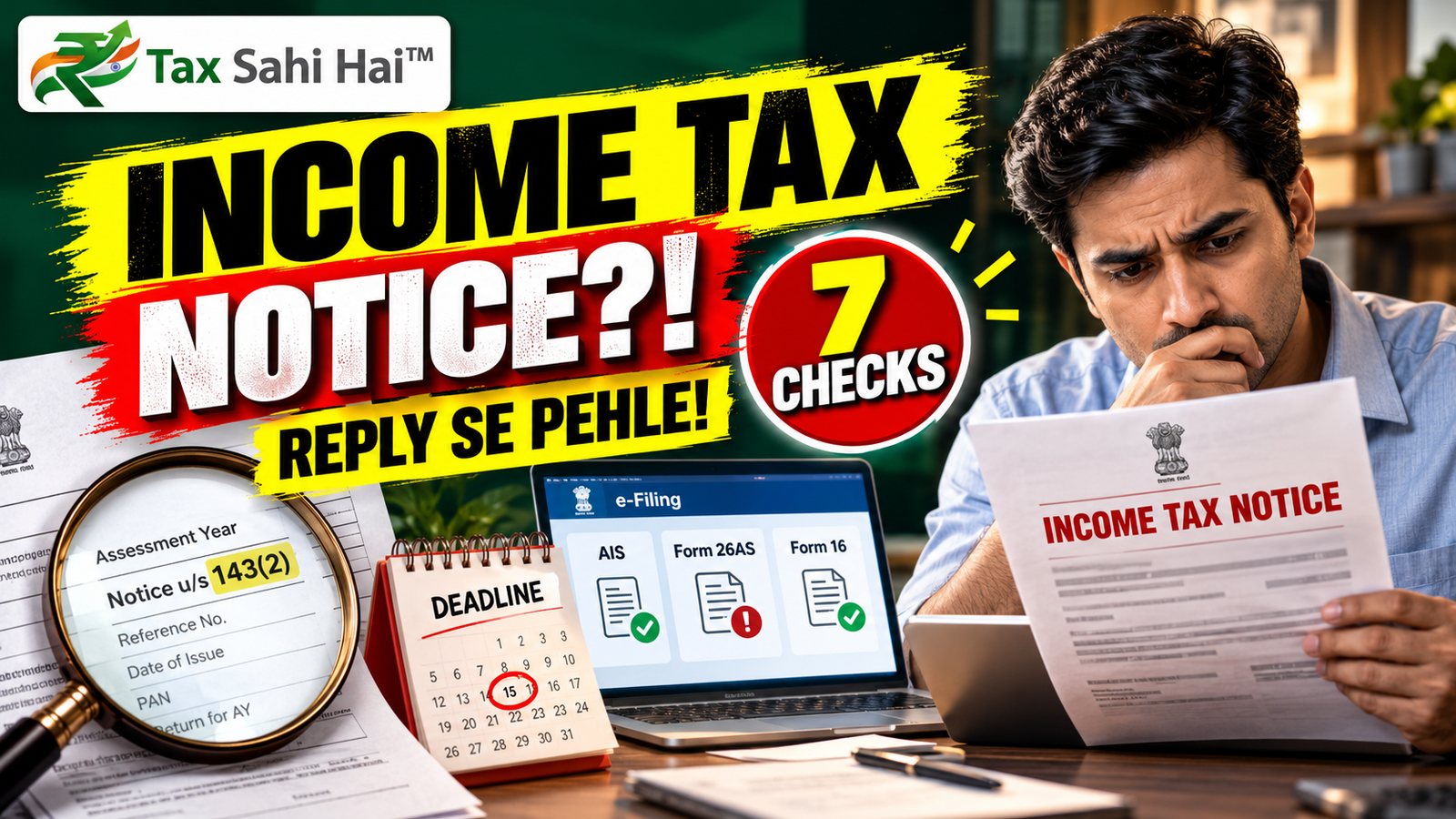
You open your inbox, see "Income Tax Department" in the sender line, and your stomach drops a little before you've even read the subject. That reaction is normal, but it's also usually unnecessary. A notice is a question, not a verdict — and how you answer it matters far more than the fact that it arrived at all.
"Most people lose more money panicking over a notice than they ever would have paid by simply reading it carefully first."
What an income tax notice actually is
An income tax notice is a formal communication from the department asking you to clarify, correct or explain something about your return — it is not, by itself, a penalty, a fine, or proof of wrongdoing. If you've never read a plain notice basics explainer before, now is a good time. Think of it closer to a query raised by a bank when a transaction looks unusual: sometimes it's a genuine issue, sometimes it's just a data mismatch that needs a two-line explanation.
The department's systems now cross-check your AIS data against what you actually declared, and a large share of notices exist purely because these two numbers didn't line up. That's a process issue far more often than it's a fraud issue — our deeper piece on AIS tracking explains how that comparison actually works behind the scenes.
A notice doesn't mean you owe money. Many 143(1) intimations simply confirm your return was processed correctly, with zero additional demand — people often panic before even checking whether there's a demand attached at all.
The sections you're most likely to see
Not all notices carry the same weight. Knowing which section you're dealing with changes how urgently and how carefully you need to respond.
Section 143(1) — intimation
This is the most common one, generated automatically after your return is processed. It flags arithmetic errors, TDS mismatches, or deduction claims that don't match third-party data. Most of these are routine and resolve with a quick correction.
Section 139(9) — defective return
Your return had a structural problem — a missing schedule, an unmatched balance sheet, an incomplete form for your income type. You typically get a fixed window to refile correctly, or the original return can be treated as invalid.
Section 142(1) — inquiry before assessment
The department wants specific documents or a return you haven't filed yet. This is more procedural than accusatory, but ignoring it has real consequences since it can precede a deeper assessment.
Section 148 — income escaping assessment
This is reassessment territory — the department believes some income wasn't reported in a past year. It carries more weight than a routine notice and usually deserves careful, documented handling rather than a quick reply.
Section 143(2) — scrutiny
Your return has been selected for detailed manual examination, often through an automated risk-based selection process. It doesn't mean you're suspected of anything specific, but it does mean every claim in your return may be examined closely — our broader note on the scrutiny process covers what that examination actually looks like.
The 7 things to check before you reply
Before you type a single word of a response, work through these in order. Skipping steps here is how simple notices turn into drawn-out back-and-forth.
1. Confirm it's genuine, on the portal itself
Fake notices circulating by email and WhatsApp are common enough that this step isn't optional. Log in directly to the e-filing portal and check whether the same notice appears under your account, with a matching Document Identification Number.
2. Note the exact section and assessment year
A notice for AY 2024-25 needs a completely different response than one for AY 2022-23. Confusing the year is a surprisingly frequent, entirely avoidable mistake that wastes your own response window.
3. Read what's actually being flagged — not what you assume
People often skim the first line and jump to conclusions. Read the specific discrepancy line item; it's usually narrower and more specific than the alarming tone of the subject line suggests.
4. Check the response deadline precisely
Deadlines are usually counted in calendar days from the date of issue, not the date you opened the email. Mark it immediately rather than estimating it later from memory.
5. Cross-check AIS, Form 26AS and Form 16 against your filed return
Most mismatches trace back to one of these three documents disagreeing with what you declared. Pull your Form 26AS directly rather than relying on memory.
6. Don't assume it's a mistake and ignore it
Even notices that look like obvious system errors need an acknowledgment or response within the window. Assuming the department will "figure it out" on its own is the single costliest assumption people make. For official section wording rather than a forwarded summary, the department site is the clearest reference.
7. Don't reply emotionally or admit anything you're unsure of
A defensive, rushed, or guilt-laden reply can create problems that didn't exist in the original notice. State facts, attach proof, and leave speculation out entirely.
TDS mismatch
Your employer or bank reported TDS figures to the department that don't match what you claimed in your return — verify the entry directly on TRACES before assuming it's an error on your side.
High-value transactions
Large deposits, property purchases or credit card spends reported under AIS that don't align with your declared income — property sales in particular are worth reading up on under capital gains timing.
Deduction claims flagged
80C, 80D or HRA claims that look unusually high relative to your salary structure or filing history — see our 80C claims breakdown for what's genuinely eligible.
Non-filing of return
Income reported by a third party exists, but no return was filed for that assessment year at all — common among freelancers with irregular income.
Common mistakes people make when replying
Beyond the seven checks above, a few patterns show up again and again. Replying before gathering every supporting document means you often end up submitting a second clarification anyway, which just extends the whole process. Another frequent error is treating the notice reply like a conversation rather than a formal submission — vague language where a specific figure or date was needed rarely helps your case.
People also sometimes confuse a notice with a demand. If an outstanding demand notice is involved, that's a separate and more time-sensitive matter than a general clarification request, and it's worth reading our note on demand notices specifically if that's what you're facing.
A common trap: people assume a reply "acknowledging receipt" without substance counts as a response. It doesn't. The department expects an actual explanation or correction, not a placeholder message.
How to actually submit a response on the portal
Once you know what's being asked, the submission process itself is fairly mechanical. The four steps below cover the full reply process from start to finish.
- 01
Verify the notice is genuine on the e-filing portal
- 02
Understand exactly which section and discrepancy applies
- 03
Gather AIS, 26AS, Form 16 and any supporting proof
- 04
Submit your response under e-Proceedings within the deadline
Responses are submitted under the e-Proceedings tab, where you select the relevant notice and choose from the available response options — agree with the discrepancy and file a revised return, or disagree and provide an explanation with documentary support. Keep acknowledgment numbers from every submission.
- Verify the notice's authenticity before reacting to it at all.
- Identify the exact section, assessment year and deadline.
- Match the flagged discrepancy against AIS, 26AS and Form 16.
- Decide whether a revised return or a factual explanation fits better.
- Keep a copy of every document and acknowledgment number submitted.
What happens if you miss the deadline
Missing the response window doesn't make the notice disappear — it usually narrows your options. The assessing officer can proceed with a best-judgment assessment using whatever data is already available, which is rarely in your favour. Depending on the section, additional interest or penalty provisions can also apply, and in scrutiny or reassessment cases, a missed deadline can mean losing the chance to present evidence informally before matters escalate further.
If you've already missed a deadline, don't assume the window has closed completely — a delayed but well-documented response is still often better than silence, and in some cases a condonation request is possible depending on the circumstances.
When to handle it yourself vs when to get professional help
A straightforward 143(1) intimation about a small TDS mismatch, where the numbers are easy to reconcile from your own Form 16, is usually fine to handle on your own. The portal's guided response flow is built for exactly this kind of case.
Scrutiny notices, reassessment under Section 148, anything involving multiple assessment years, or disputes over large sums are where professional input earns its cost quickly. Misjudging the strength of your own explanation in those cases can be far more expensive than the fee for getting it reviewed properly. If the underlying issue is really about correcting a filed return rather than disputing the notice itself, our guide on revised return options is worth reading alongside this one.
If the same discrepancy keeps appearing year after year — say, a recurring HRA mismatch — it's usually a salary structuring issue, not a filing mistake. Fixing the root cause saves you from repeat notices altogether.
Never ignore a notice assuming it's spam or a phishing attempt without checking the portal first. Genuine notices sometimes do look unpolished, and dismissing a real one as fake carries the same consequences as ignoring it outright.
A quieter habit that prevents most notices
The single biggest preventive step is checking your AIS and tax liability before you file, not after a notice forces you to. Most of the mismatches that trigger a notice were visible in AIS weeks before the return was even due — they just went unchecked.
It's also worth revisiting how TDS gets deducted through the year, since a chunk of notices trace back to payslip-stage mismatches that could have been caught long before assessment time — our piece on avoidable TDS losses covers exactly this pattern.
How Tax Sahi Hai Can Help
Reading a notice correctly and responding to it correctly are two different skills, and most of the stress people feel comes from not being sure they've got either one right.
| What You Need | How We Help | Link |
|---|---|---|
| Understand and respond to a notice correctly | Review the exact section, draft the response, and track the deadline for you. | Notice resolution |
| Fix the underlying mismatch in your filing | Correct AIS, 26AS or 80C/HRA discrepancies at the source, not just on paper. | Compliance correction |
| Decide between handling it yourself or escalating | A clear read on whether your case needs representation or a simple reply. | Expert advisory |
Frequently asked questions
Does getting an income tax notice mean I've done something wrong?
No. Most notices, especially under Section 143(1), are routine system-generated communications comparing your return against AIS and Form 26AS data. A mismatch doesn't automatically mean fraud or penalty — it often just means something needs clarifying or correcting.
How do I know if a notice I received is actually genuine?
Log into the e-filing portal directly, not through any link in an email or SMS, and check the 'View Notices/Orders' section under e-Proceedings. If a notice doesn't appear there with a matching Document Identification Number, treat it as suspicious.
What's the difference between Section 143(1) and Section 143(2) notices?
143(1) is an automated intimation after processing your return, usually about arithmetic or data mismatches. 143(2) is a scrutiny notice, meaning your return has been picked for a detailed manual review — a far more serious matter requiring careful documentation.
What happens if I miss the deadline to respond to a notice?
The assessing officer can proceed with a best-judgment assessment based on available data, often unfavourable to you, and you may lose the chance to present your side easily. Penalties and additional interest can also apply depending on the section involved.
Can I fix a mistake in my return after getting a notice, instead of just replying?
In many cases yes — if the notice relates to a genuine error on your part, filing a revised return before responding can resolve things faster than arguing the point. This depends on the section and whether the filing window for a revision is still open.
Should I always reply myself, or get a professional involved?
Simple 143(1) mismatches with clear explanations are often fine to handle yourself. Scrutiny notices under 143(2), reassessment under Section 148, or anything involving large sums or multiple years is where professional help pays for itself quickly.
Is there a fee for responding to an income tax notice on the portal?
No, submitting a response through the e-filing portal itself is free. Costs only arise if you engage a professional for drafting the response or representing you, which is optional depending on the notice's complexity.
Will replying to a notice trigger a deeper investigation into my other returns?
Not typically. Responses are generally assessed in the context of the specific notice and assessment year mentioned. A clear, well-documented reply usually closes the matter without inviting further scrutiny into unrelated years.
Got a notice and not sure what it means?
A calm, correct response within the deadline is worth far more than a fast, panicked one.
Talk to Tax Sahi Hai and get clarity on exactly what your notice needs from you.