How the Income Tax Department Tracks Your Income (Scary but True)
You think your income is private? Think again. The Income Tax Department uses powerful systems to track every rupee you earn, spend, and invest. Here is exactly how they do it.
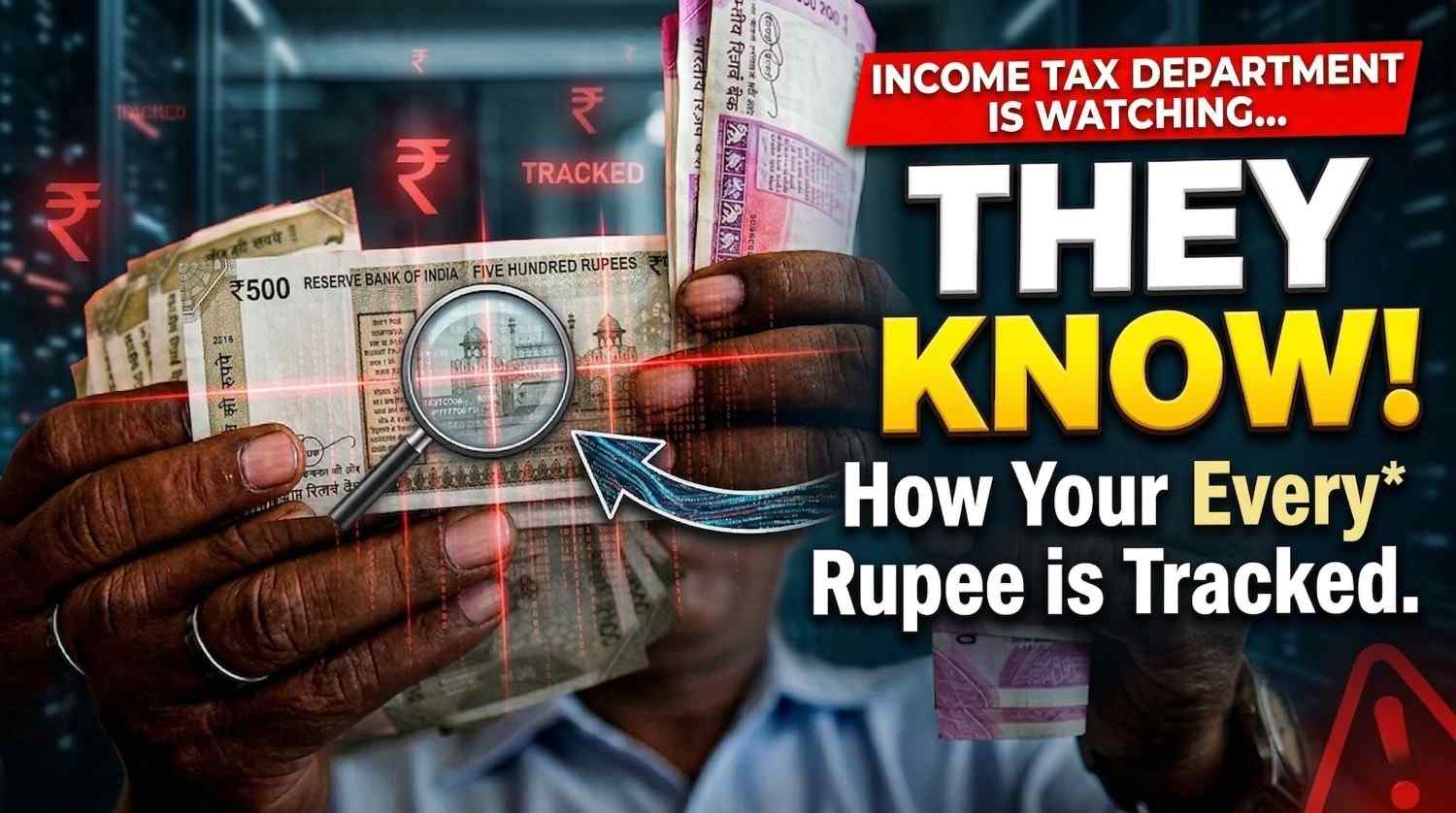
The Government Knows More Than You Think
Imagine this. You sell a piece of land your father left you. You do not report it in your tax return because, well, nobody was watching. Six months later, you receive a notice from the Income Tax Department asking you to explain that exact transaction.
You think: how did they know?
The answer is: they always knew. They just waited. Today, the Income Tax Department in India uses some of the most advanced data collection and cross-verification systems in Asia. Every bank transaction, every mutual fund purchase, every property deal, and even your foreign travel is quietly logged and matched against your tax return. If there is a gap, a notice arrives at your door.
This is not meant to scare you. It is meant to prepare you. Understanding how the tracking works is the first step to making sure you never get caught on the wrong side of it. And if you ever do receive a notice because of a mismatch, our Notice Resolution service exists exactly for that moment.
The Annual Information Statement (AIS): Your Financial Shadow
The most powerful tool in the Income Tax Department's arsenal is something called the Annual Information Statement, or AIS. It was introduced in 2021 and has completely changed the game for taxpayers.
Think of the AIS as a shadow file that the government maintains for every taxpayer. While you go about your financial life, buying mutual funds, receiving dividends, selling shares, depositing cash in your bank account, the AIS is silently recording all of it. When you log in to the Income Tax portal and download your AIS, you will often be shocked to see how much the government already knows about you.
| Category | What Is Reported |
|---|---|
| Salary | Reported by your employer via TDS returns |
| Bank Interest | Reported by every bank where you hold an account |
| Dividends | Reported by companies where you hold shares |
| Mutual Fund Transactions | Reported by AMCs and SEBI-registered entities |
| Share Sales | Reported by stock depositories like NSDL and CDSL |
| Property Deals | Reported by Sub-Registrars of properties |
| Cash Deposits | Reported by banks for deposits above Rs. 10 lakh per year |
| Foreign Remittances | Reported under the Liberalised Remittance Scheme (LRS) |
The AIS is accompanied by something called the Taxpayer Information Summary (TIS). The TIS gives a simplified version of the same data and is what the system actually compares against your filed return. If the numbers do not match, a data mismatch is flagged and you are sent a notice.
Form 26AS: The Original Tracking Document
Before the AIS became the main tracking tool, Form 26AS was the primary document the department used. It is still very much active and relevant today. Form 26AS is essentially a tax credit statement. It shows all the Tax Deducted at Source (TDS) that has been deducted from your income by your employer, bank, or any party that paid you.
Here is the important thing to understand: every entity that deducts TDS from your income must file a TDS return with the government. This return automatically updates your Form 26AS. So even if you do not file your income tax return, the government already knows your salary, your bank interest, your freelance income, and your rental income, because the people who paid you reported it.
Real-Life Example:
Ramesh works as a senior manager at a private company in Pune. His salary of Rs. 18 lakh per year is reported in Form 26AS via his employer's TDS return. He also has a savings account at two different banks. Both banks report his interest income separately. He thought he only needed to show his salary in his return. But when his notice arrived, it showed income from all three sources and asked him to explain why the interest income from one bank was never reported. His income tax notice had the exact rupee amounts already filled in.
The Statement of Financial Transactions (SFT): High Value Radar
The Income Tax Department runs what is essentially a high value transaction radar through the Statement of Financial Transactions (SFT). This is a mandatory reporting requirement placed on specific financial institutions and entities. Basically, if you do anything big with money, someone is required by law to tell the government about it.
Banks Report Cash Deposits Above Rs. 10 Lakh
If you deposit Rs. 10 lakh or more in cash in any one bank account in a financial year, the bank is legally required to report it. This applies to savings accounts. For current accounts, the limit is Rs. 50 lakh. If you deposit just below the limit across multiple accounts to avoid detection, the department's system checks for this pattern too.
Property Registrars Report Deals Above Rs. 30 Lakh
Every Sub-Registrar office in India is required to report any property purchase or sale that exceeds Rs. 30 lakh. So if you buy a flat for Rs. 75 lakh paying mostly in cash, the registrar reports the deal. The department then compares this against your declared income and asks: where did this money come from?
Credit Card Spends Above Rs. 1 Lakh Per Month
Banks are required to report it if you pay more than Rs. 1 lakh in a single month toward your credit card bill in cash. Payments above Rs. 10 lakh through any mode in a year are also flagged. This helps the department spot people whose spending patterns do not match their declared income.
Mutual Fund Purchases Above Rs. 10 Lakh
If you invest Rs. 10 lakh or more in mutual funds in a single financial year, the AMC (Asset Management Company) reports this transaction. The department then checks if you had declared enough income over the years to afford such an investment.
Share and Bond Purchases Above Rs. 10 Lakh
Purchases of shares, debentures, or bonds above Rs. 10 lakh in a year trigger reporting by your broker or the depository (NSDL or CDSL). All sale transactions are also reported regardless of the amount, allowing the department to compute your capital gains independently.
Fixed Deposits Above Rs. 10 Lakh
If you open a fixed deposit for Rs. 10 lakh or more, the bank reports the transaction. This is separate from interest reporting. So both the principal and the interest are visible to the department.
PAN: The Thread That Connects Everything
Your Permanent Account Number (PAN) is the single thread that ties all your financial data together. Every major financial transaction in India is linked to your PAN. When you open a bank account, buy a car, invest in stocks, purchase a property, or even book a foreign tour package above a certain value, your PAN is collected and reported.
This is why the Income Tax Department does not need to chase you for information. All your financial institutions are already sending them your data automatically. Your PAN acts like a unique identifier that the system uses to pull all these threads together into one complete financial picture of your life.
Transactions That Require Your PAN:
- Opening a bank account or fixed deposit
- Buying or selling property
- Purchasing a vehicle above Rs. 10 lakh
- Booking a foreign tour package above Rs. 50,000
- Applying for a credit card
- Investing in stocks, mutual funds, or bonds
- Paying restaurant bills or hotel bills above Rs. 50,000 in cash
- Cash deposits above Rs. 50,000 in a single transaction at a bank
The Computer Algorithm That Reviews Every Return
Many people believe that since so many crore returns are filed, the department cannot possibly check all of them. This is a dangerous myth. The Income Tax Department uses an advanced computer system called the Centralised Processing Centre (CPC) that processes every single return filed in India automatically.
The CPC runs an algorithm that compares your filed return against the data in your AIS and Form 26AS. It checks for mismatches. It checks for unreported income. It checks for claimed deductions that seem too high. And when it finds something suspicious, it automatically generates a notice and sends it to you. There is no human involved in this step. It is all machine-driven.
This is why the system is so efficient. A human tax officer cannot check 8 crore returns. But a computer can check all of them simultaneously and flag the problematic ones within seconds. This automated notice is usually a Section 143(1) intimation, the most common type of notice taxpayers receive today.
If you have received one of these, do not panic. You can use our free Notice Decoder tool to understand what your notice means and what action is required.
The Faceless Assessment: An Officer Is Watching, Just Not in Your City
The Income Tax Department introduced the Faceless Assessment Scheme in 2020, and it changed how scrutiny works entirely. Before this, if your return was selected for detailed examination, you would deal with the assessing officer in your city. There was room for personal discretion, delays, and sometimes misuse.
Under the new faceless system, your case is randomly assigned to an assessing officer anywhere in India without either of you knowing who the other is. All communication happens online through the Income Tax e-filing portal. The officer reviews your documents, raises queries, and passes orders without ever meeting you. This makes the system much more objective and efficient, and also much harder to navigate without professional help.
Cases selected for faceless scrutiny are usually high-value, have complex transactions, or have been flagged by the algorithm for specific reasons. If you receive a scrutiny notice under Section 143(2), it is a sign that your case has been selected for this detailed review and you should respond carefully.
GST Data and Income Tax: Two Systems Talking to Each Other
If you run a business and are registered under GST, your income tax department and GST department are now sharing data. The GST system collects detailed information about every sale you make and every purchase you claim as a business expense. This data is then cross-verified against your income tax return.
For example, if your GSTR-1 shows sales of Rs. 80 lakh in a year but your income tax return shows a turnover of Rs. 50 lakh, the system catches this mismatch automatically. The same works the other way. High expenses claimed in income tax filings are matched against GST data to verify if genuine business activity took place.
This is why a business owner cannot afford to maintain inconsistent records across both systems. The two systems talk to each other and any gap will be caught. If you have any concerns about your business filings, our Compliance Correction service can help you review and clean up your records before they attract a notice.
Project Insight: The Big Data Project No One Talks About
One of the least discussed but most powerful tools in the Income Tax Department's tracking system is something called Project Insight. Launched in 2017, this is a massive data analytics project built in collaboration with global technology companies. Its purpose is to gather information from multiple sources, connect the dots, and build a comprehensive risk profile of every taxpayer.
Under Project Insight, the department collects and analyses:
Financial Data Sources
- Bank account statements and transactions
- Credit card spending patterns
- Loan applications and repayments
- Investment portfolio details from depositories
- Foreign currency purchases and travel bookings
- Property registrations and valuations
Lifestyle and Behaviour Data
- Social media profiles and posts (publicly available)
- Import and export data for business owners
- Company director and shareholder information from MCA
- Customs data on overseas purchases
- Intelligence reports from foreign tax authorities
- Long-term spending behaviour vs declared income
The risk profile generated by Project Insight determines which returns get flagged, which taxpayers receive notices, and which cases go to full scrutiny. If your lifestyle spending suggests income much higher than what you declared, Project Insight raises your risk score, and the system takes notice.
How Non-Filers Get Caught
Every year, the Income Tax Department runs something called the Non-Filer Monitoring System (NMS). This system automatically identifies individuals who have not filed a tax return but who show signs of taxable income based on the data available with the department.
Here is how you can be identified as a non-filer even if you think you have no obligation to file:
Your employer deducts TDS from your salary
This creates an entry in your Form 26AS. If you never file a return to claim the credit or confirm your income, the NMS flags you as a person with declared income who did not file a return.
You made a large cash deposit or investment
If you deposited Rs. 15 lakh in cash at your bank and never filed a return, the NMS system sees a high-value transaction with no corresponding tax filing. This almost always triggers a notice.
You received dividends or mutual fund gains
Companies and AMCs report dividend and redemption payments. If these are above the basic exemption when combined with other income, you are expected to file a return. The NMS checks for this and sends notices to those who skipped.
What Happens If the Department Finds a Gap
When the system identifies a discrepancy between what you reported and what the data shows, a few things can happen depending on the severity:
Step 1: You Receive an Intimation Under Section 143(1)
This is the mildest level. The system tells you there is a difference and proposes an additional tax demand. You can agree and pay, or you can disagree and submit your explanation with documents. Most cases at this level are resolved without major consequences if you respond correctly and on time.
Step 2: Your Case Gets Selected for Scrutiny Under Section 143(2)
This is a more serious step. You are now in the faceless assessment system. An officer reviews your full return, asks detailed questions, and can disallow your deductions or add unreported income. This can lead to a large demand notice if not handled carefully.
Step 3: Reassessment of Past Returns Under Section 147 or 148
In serious cases, the department can reopen your returns from previous years if they believe income was underreported. This can go back up to 10 years in cases of large undisclosed income or foreign assets. Once this process begins, you are essentially fighting a reopened case for multiple financial years simultaneously.
Step 4: Penalty and Prosecution
If the department concludes that income was deliberately concealed rather than accidentally omitted, they can impose a penalty of 50 to 200 percent of the tax evaded. In the most serious cases involving fraud or systematic evasion, criminal prosecution is also possible.
What You Can Actually Do About This
The tracking systems described in this article are not going away. They will only get more sophisticated over time as India's tax infrastructure improves. The good news is that these systems are not designed to trap honest taxpayers. They are designed to catch people who deliberately hide income. If you are filing honestly, most of this does not affect you directly.
But here is the thing: many people get caught not because they were dishonest, but because they were careless. They forgot to report bank interest. They did not know that a property sale generated capital gains. They claimed a deduction for which they had no proof. These are honest mistakes, but the system treats them the same way.
Here is what every responsible taxpayer should do to stay clean:
1. Download Your AIS Every Year Before Filing
Log in to the income tax portal and download your AIS before you file your return. Make sure every income source shown in the AIS is either reported in your return or corrected through the feedback mechanism if the data is wrong.
2. Report All Interest Income, Not Just Major Amounts
Many people report salary but forget to include savings account interest, fixed deposit interest, and interest from post office schemes. These are all reported by banks and post offices. Even if the amount is small, include it in your return.
3. Report Capital Gains from Mutual Funds and Shares
Every redemption you make from a mutual fund is tracked. Every share you sell on the stock exchange is recorded. The depository reports it to the department. Make sure your capital gains, whether short-term or long-term, are correctly reported.
4. Keep Documents Ready for All Claims
Every deduction you claim must be backed by a real document. If you claim HRA, keep rent receipts. If you claim 80C, keep your investment proof. If you carry forward a capital loss, make sure the original transaction is documented. A deduction without proof is an invitation for a notice.
5. File Your Return Even If You Are Below the Taxable Limit
If you have made large financial transactions in a year even with low income, it is often better to file a return showing all transactions with explanations. A filed return with zero tax is much safer than a non-filing record when large transactions are present in the system.
Already Received a Notice? Here Is What to Do
If you have already received a notice because of a mismatch or unreported income, acting quickly and correctly is the most important thing you can do. The worst thing is to ignore it. An ignored notice leads to an automatic demand order, and an ignored demand leads to bank account attachment.
At Tax Sahi Hai, we help you understand the notice, gather the right documents, and draft a proper legal response that addresses the department's concerns completely. Explore our Solutions to see how we resolve notices, fix compliance errors, and help you stay clean going forward.
If you are unsure about your current tax position or want someone to review your past filings before a notice arrives, you can speak with our team directly. We offer confidential consultations and will tell you exactly where you stand.
Conclusion
The Income Tax Department is not your enemy. But it is not careless either. Today's tax infrastructure in India is built on a foundation of data sharing, automated verification, and algorithmic risk profiling. Every financial institution, every registrar, every broker, and every employer feeds data into a central system that builds a picture of your financial life year after year.
If your declared income matches this picture, you will never hear from them. If there is a gap, whether from a genuine mistake or deliberate hiding, a notice will arrive. The smartest thing any taxpayer can do is to make sure the picture they show the department exactly matches the one the department is already building on its own.
File honestly. Report completely. Keep your documents ready. And if you ever feel unsure about something, get expert help before the notice arrives rather than after. That is what Tax Sahi Hai is here for.