How the New Tax Regime Actually Affects Your Salary (Real Numbers)
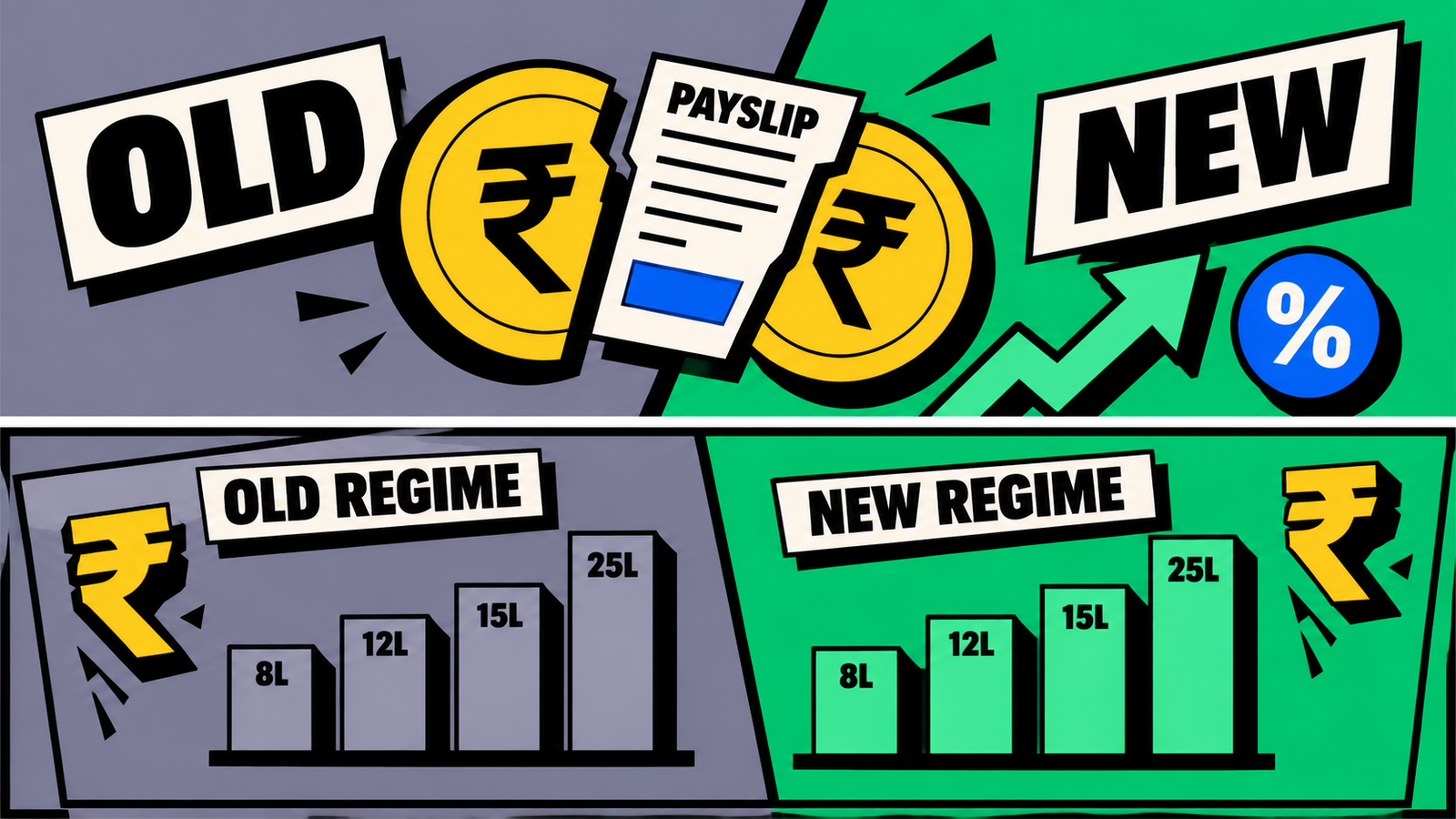
Real salary numbers at ₹8L, ₹12L, ₹15L and ₹25L CTC, compared old vs new regime — so you can see exactly what the new tax regime means for your take-home pay this year.

Every March, someone in your office group chat says "just go with the new regime, it's simpler," and half the room nods along without doing a single calculation. The new regime is genuinely better for a lot of people — but "a lot" is not "everyone," and the gap between those two words can cost you real money.
"The new regime didn't make tax simpler. It made the decision of which regime to pick more important than ever."
What actually changed in the new regime
The new tax regime became the default option starting FY 2023-24, and the FY 2025-26 Union Budget pushed it further by widening the slabs and increasing the rebate ceiling. The core idea hasn't changed: lower slab rates in exchange for giving up most deductions and exemptions. What has changed is that the trade now favours a much wider income band than it did two years ago.
The standard deduction for salaried employees and pensioners is now ₹75,000 under the new regime, up from the earlier ₹50,000. Combined with the Section 87A rebate, this means a salaried person can earn up to roughly ₹12.75 lakh in gross salary and pay zero tax — provided they have no other complicating income. That single number is why so many mid-level earners suddenly find the new regime attractive when it wasn't before.
Zero tax up to ₹12.75L salary doesn't mean the slabs above that point are also free. Once your taxable income crosses the rebate threshold, tax is computed on the full slab structure, not just the excess.
The new regime slabs, plainly
Here's the FY 2025-26 new regime slab structure applied to taxable income (after standard deduction):
Between ₹4L and ₹24L, the rate climbs in steps — 5%, 10%, 15%, 20%, 25% — before settling at 30% beyond ₹24L. It reads like a gentle staircase rather than the old regime's steeper jumps, which is exactly why it favours people without large deductions to protect.
For the exact current slab table and any mid-year clarifications, the Income Tax Department portal remains the authoritative source — screenshots from last year's WhatsApp forward are not.
Real numbers: four salary levels compared
Slabs on paper mean little until you see them against an actual CTC. Here's a rough comparison assuming a fairly standard salary structure with HRA and a modest 80C claim under the old regime.
₹8 lakh CTC
At this level, most people pay close to nothing either way. Under the new regime, tax works out to roughly zero after the rebate. Under the old regime, with a reasonable HRA and 80C claim, tax also lands near zero. There's no meaningful difference here — pick the new regime for simpler paperwork.
₹12 lakh CTC
This is the band where the rebate does its heaviest lifting. Taxable salary after the ₹75,000 standard deduction often falls under the ₹12.75L rebate ceiling, meaning zero tax under the new regime. Under the old regime, unless HRA and 80C claims are unusually large, tax typically runs into low five figures. New regime usually wins here — verify the exact rebate mechanics on the tax portal rather than a forwarded PDF.
₹15 lakh CTC
This is where the calculation genuinely splits people into two camps. Someone renting in a metro with full HRA exemption, a maxed-out 80C, health insurance under 80D and home loan interest can pull taxable income down enough that the old regime wins — sometimes by ₹30,000-₹50,000. Someone with the same CTC but no rent, no home loan and minimal 80C usage almost always does better under the new regime. Use our income tax calculator at this level rather than guessing.
₹25 lakh CTC
At higher incomes, the new regime's lower slab rates matter more in absolute terms, but so does the size of a home loan interest deduction, which is capped but still substantial. This band deserves an actual side-by-side calculation rather than a rule of thumb, because the difference can run into a few lakh rupees depending on your specific deductions.
Who genuinely benefits from the new regime
Early-career and mid-level earners
If your salary is under ₹15L and you don't pay significant rent or have a home loan, the new regime almost always wins with less paperwork.
People without a home loan
Home loan interest deduction is the old regime's biggest lever. Without it, the old regime loses most of its appeal.
Anyone who dislikes proof submission
No rent receipts, no LIC premium receipts, no chasing your landlord for a PAN in December.
Employees with strong employer NPS contribution
Section 80CCD(2) survives under the new regime, so employees whose companies contribute generously to NPS keep that benefit either way.
The same salary-band logic applies loosely to how capital gains are taxed — simpler income profiles tend to benefit from simpler rules, while layered income and investments usually reward more deliberate planning.
Who should still consider the old regime
- You're paying substantial rent in a metro city and can claim full HRA exemption.
- You have an active home loan with meaningful annual interest outgo.
- You consistently max out Section 80C, 80D and other Chapter VI-A deductions already.
- Your total eligible deductions comfortably exceed ₹4-4.5 lakh in a year.
If two or more of these apply to you, don't assume the new regime is better just because it's the default. A large home loan also means tracking interest-rate movements — the RBI rate cycle directly affects how much that deduction is actually worth to you this year. Run the numbers rather than a mental estimate, and if the case is close, our tax bill guide covers deduction stacking that applies to both regimes.
What deductions still survive under the new regime
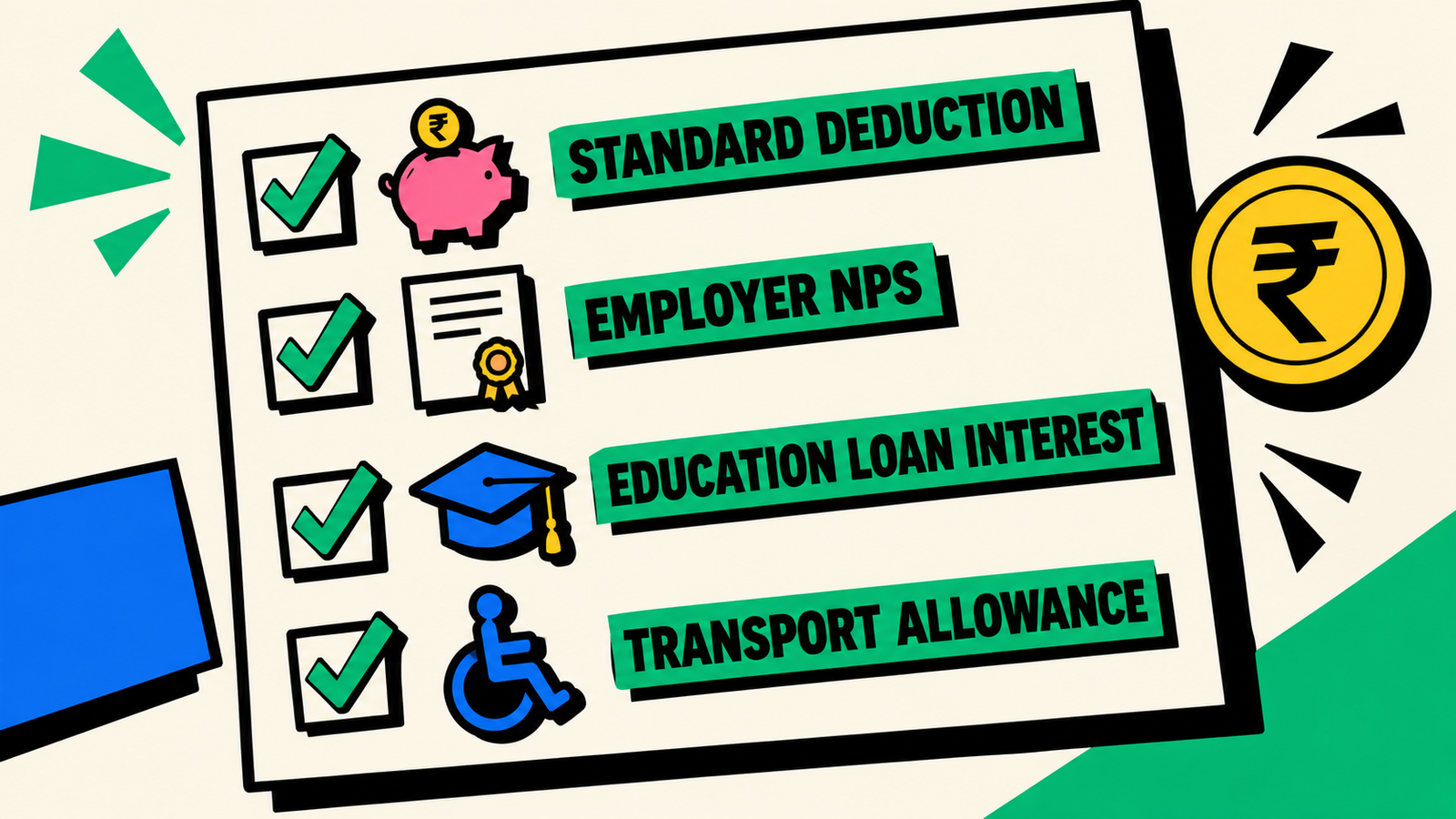
The new regime isn't a total blank slate. A handful of deductions remain, and missing them is a common, avoidable mistake.
- 01
Standard deduction of ₹75,000 for salary income
- 02
Employer NPS contribution under 80CCD(2)
- 03
Interest on education loan under 80E
- 04
Transport allowance for specified disabled employees
The standard deduction applies automatically — you don't need to submit anything to claim it. But employer NPS contribution under 80CCD(2) only helps if your company's payroll structure actually includes it, so check your salary breakup against the account details on the NPS Trust site.
Common mistakes people make with the regime choice
The most expensive mistake isn't picking the "wrong" regime — it's not comparing at all. A close second is comparing once at the start of the year and never revisiting it, even after a salary hike, a new home loan, or a rent increase changes the math entirely. A related pattern shows up in our piece on overlooked deductions, where people default to the familiar option instead of checking what's actually available to them.
Another frequent error: assuming the regime choice made through your employer for TDS purposes is locked in for your final return. It isn't, for most salaried employees. If your employer deducted TDS assuming the new regime but the old regime actually suits you better, you can still choose the old regime while filing your ITR and claim the difference as a refund.
If you have business or professional income alongside salary, the rules change — you get only one chance to switch back to the old regime after opting out. Salaried-only individuals face no such restriction and can switch every year.
When to tell your employer and why timing matters
Most employers ask for your regime preference in April, at the start of the financial year, so TDS is deducted on the correct basis through the year. If you miss this window, many employers default to the new regime for TDS purposes, which can mean higher monthly deductions if you actually intended to claim old-regime benefits — see our guide on avoidable TDS losses for the broader pattern.
This doesn't lock your final outcome — the return you file settles the actual tax owed — but a mismatch between TDS assumptions and your real choice creates cash flow friction you didn't need. If you've already gone through a declaration deadline and picked wrong, it's still fixable at filing time; it just costs you liquidity in the meantime rather than actual tax.
A simple way to decide, without a spreadsheet obsession
You don't need a finance degree to make this call reasonably well. Add up your likely HRA exemption, 80C usage, 80D premium and home loan interest for the year. If that total is under roughly ₹3 lakh, the new regime is very likely better for you. If it's comfortably above ₹4-4.5 lakh, the old regime deserves serious consideration. In the middle zone, that's when an actual calculation — not a guess — earns its keep.
For a broader look at how deductions interact with each regime choice, our guide on 80C, 80D, 80E breaks down which of those old-regime benefits are worth chasing in the first place, separate from the regime question itself.
What this means if your salary structure hasn't been reviewed in a while
Salary structures built years ago, back when the old regime was the only option, often still carry components like LTA and heavy HRA weighting that made sense then but add complexity now. If you've moved to the new regime, it's worth asking HR whether your CTC breakup can be simplified, since several of those components no longer serve their original tax purpose for you.
This is also a good moment to check your Form 16 carefully once it arrives, since payroll systems occasionally default to the wrong regime assumption for an employee who changed their declaration mid-year.
How Tax Sahi Hai Can Help
Choosing between regimes is a numbers problem, but acting on the right numbers is where most people fall short.
| What You Need | How We Help | Link |
|---|---|---|
| Compare old vs new regime accurately | Run your actual salary structure through both regimes before you decide. | Tax planning |
| Fix a wrong regime declared to your employer | Guidance on correcting your choice at filing time and claiming the refund. | Compliance correction |
| Restructure salary or investments around your choice | A practical review of HRA, NPS and 80C usage against your regime. | Expert advisory |
Frequently asked questions
Is the new tax regime automatically applied to my salary?
Yes. Since FY 2023-24, the new tax regime is the default option. If you want the old regime instead, you must actively opt for it — either by informing your employer at the start of the year or while filing your ITR, if you have no business income.
Can I switch between old and new regime every year?
Salaried individuals without business or professional income can switch every financial year at the time of filing. If you have business income, you get only one opportunity to switch back to the old regime after opting out of it once.
Do I lose HRA exemption completely under the new regime?
Yes, HRA exemption is not available under the new regime. If a large chunk of your salary structure is HRA and you pay significant rent, this is often the single biggest reason the old regime works out cheaper for you.
Is the ₹75,000 standard deduction available to everyone under the new regime?
It's available to all salaried individuals and pensioners with salary income, regardless of income level. There's no minimum salary threshold to claim it — it applies automatically when computing your taxable salary.
What happens to my 80C investments if I choose the new regime?
They simply stop reducing your taxable income. Your ELSS, PPF or insurance premium payments remain valid investments for their own purpose, but they no longer lower your tax bill under the new regime.
Is employer NPS contribution still deductible under the new regime?
Yes. Employer contribution to NPS under Section 80CCD(2) continues to be deductible under the new regime, up to 14% of basic salary for most employees. This is one of the few deductions that survives the switch.
Do I need to tell my employer which regime I'm choosing?
Yes, at the start of the financial year, so TDS is deducted correctly through the year. You can still change your final choice at the time of filing your return, and any excess TDS deducted gets refunded.
Will the new regime always give me a lower tax bill than the old one?
Not always. It depends heavily on how much you claim under HRA, 80C, 80D and home loan interest. Someone with minimal deductions almost always does better under the new regime; someone with a home loan and full 80C usage may still prefer the old one.
Don't let the default regime decide for you
A five-minute comparison against your actual salary structure can be worth tens of thousands of rupees, either way.
Talk to Tax Sahi Hai and get a clear answer on which regime suits you this year.