Pvt Ltd vs LLP vs Sole Proprietorship: Which Structure Saves the Most Tax for Your Indian Startup?
Most Indian founders choose their business structure based on what a friend suggested or what their CA recommended in five minutes. That single decision can cost lakhs in unnecessary tax every single year.
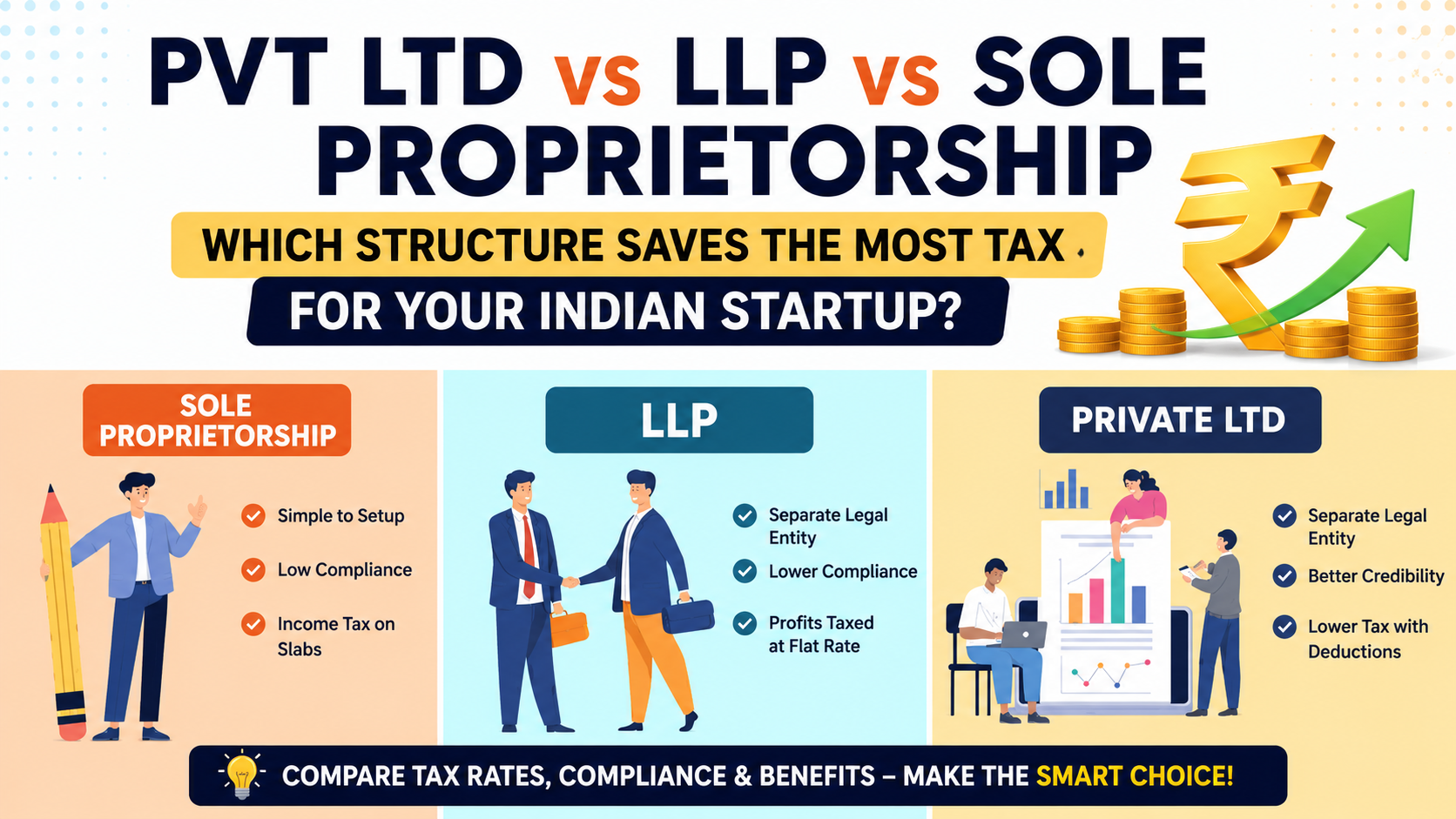
Arjun had been a product manager at a Bengaluru startup for six years. He knew how to build products, manage teams, and convince clients. But when he finally decided to launch his own SaaS business in early 2024, he ran into a question nobody had prepared him for.
His CA said go with a Private Limited Company. His cousin who ran a consultancy said just start as a sole proprietor. His former colleague who had built a successful services firm told him an LLP was the smartest move. Three people, three completely opposite answers, and not one of them showed him the actual numbers.
If Arjun had made the wrong choice that day, he would have been overpaying tax every single year without knowing it. This article is the conversation Arjun needed, but did not get.
Why This Decision Matters More Than You Think
The Indian tax system does not have a single rule book for all businesses. It has three completely different frameworks, each with its own tax rates, its own deduction logic, its own compliance obligations, and its own relationship between the business and its owner.
A sole proprietor lives inside the individual income tax framework. An LLP is taxed as a separate entity at a flat corporate rate, but its profits flow out to partners without a second layer of tax. A private limited company is taxed at the reduced corporate rate but faces double taxation risk when profits are distributed as dividends.
The structure you register on day one is not just an administrative decision. It is a decision about which tax rate will apply to every rupee of profit your business generates for the next several years. Most founders never think about it this way.
The Sole Proprietorship: Simple to Start, but a Tax Ceiling as You Grow
Meet Priya. She is a 26-year-old freelance UX designer in Mumbai who earns around Rs. 18 lakhs a year from a steady roster of clients. She set up as a sole proprietor because it was free, required no registration fees, and let her start working within a day.
A sole proprietorship has no separate legal identity. Priya is the business. The business is Priya. Every rupee her business earns flows directly into her personal income tax return and gets taxed at her individual income tax slab.
At Rs. 18 lakhs total income under the new tax regime in the financial year 2024-25, after the standard deduction of Rs. 75,000, her taxable income is approximately Rs. 17.25 lakhs. Her total income tax comes to roughly Rs. 2.22 lakhs. That is an effective tax rate of around 12.3%, which is quite reasonable.
She also benefits from Section 44ADA, the presumptive taxation scheme designed for specified professionals. Under this provision, she can declare 50% of her gross professional receipts as her taxable income, without maintaining any detailed books of accounts. For a gross income of Rs. 18 lakhs, her declared income under Section 44ADA is Rs. 9 lakhs, which brings her tax close to zero under the new regime after the Rs. 75,000 standard deduction.
This is a powerful benefit. For many freelancers, the sole proprietorship combined with Section 44ADA is genuinely one of the most tax-efficient structures available in India.
But Here Is Where the Story Changes
Two years into her practice, Priya landed a corporate retainer worth Rs. 60 lakhs per year. Suddenly she was earning Rs. 78 lakhs in total. At this level, even with Section 44ADA (50% presumptive income of Rs. 39 lakhs), her tax liability climbs sharply. And if her gross receipts exceed the Section 44ADA threshold of Rs. 75 lakhs, she must maintain full books and get a tax audit, eliminating the simplification benefit entirely.
At Rs. 78 lakhs gross income taxed fully as individual income under the new regime, her tax surpasses Rs. 20 lakhs. Every rupee she makes is taxed as personal income with no way to retain any portion of it at a lower business rate inside the entity.
This is the fundamental limit of the sole proprietorship. It works brilliantly at low incomes. It becomes a tax trap at high incomes.
The sole proprietorship structure also offers no limited liability. If a client sues Priya for a project that went wrong, her personal bank accounts, savings, and assets are all exposed. This is a significant reason to graduate out of the sole proprietorship as the business grows. You can read more about how personal financial exposure can become a serious risk on our Problems page.
The LLP: The Middle Path That Most Founders Underestimate
Rahul and Sneha started a management consulting firm together in 2022. They chose a Limited Liability Partnership because it offered them limited personal liability, a formal partnership structure, and a tax treatment that was fundamentally different from what either of them would have paid as individuals.
An LLP is taxed as a separate entity at a flat rate of 30% on its profits. No surcharge applies unless the total income exceeds Rs. 1 crore. With a 4% health and education cess, the effective tax rate for an LLP with income below Rs. 1 crore is 31.2%.
At first glance, 31.2% sounds worse than what a well-structured individual might pay. But the LLP has a feature that makes it uniquely powerful: profit distributions to partners are completely tax free.
Under Section 10(2A) of the Income Tax Act, a partner's share of profit in the income of the LLP is fully exempt from income tax in the partner's hands. This is the complete opposite of how dividends work in a private limited company. The LLP is taxed once at the entity level. The money that flows out to partners after that comes out clean, with no further tax.
The Partner Remuneration Advantage
Before the LLP pays tax on its profits, it can deduct partner remuneration as a business expense. Under Section 40(b) of the Income Tax Act, the LLP can pay each working partner a salary or remuneration, and this amount is deducted from the LLP's taxable income before the 30% rate is applied.
The permissible limits under Section 40(b) are as follows. On the first Rs. 3 lakhs of book profit: Rs. 1,50,000 or 90% of book profit, whichever is higher. On the balance of book profit: 60% of the remaining book profit.
This means that if the LLP earns Rs. 50 lakhs in profit, it can pay Rahul and Sneha significant remuneration amounts that are deducted before the 30% tax rate is applied. Rahul and Sneha then pay personal income tax on their individual salaries at their respective slab rates, which may be lower than 30% depending on their total income.
The combined effect is that the total tax paid by the LLP and both partners together is often significantly lower than 30% of the total profit, because a large portion of the income ends up being taxed at individual slab rates below 30%.
The LLP also offers simpler governance than a private limited company. There are no mandatory board meetings or board resolutions for routine decisions. A statutory audit is required only if the LLP's annual turnover exceeds Rs. 40 lakhs or if the capital contribution exceeds Rs. 25 lakhs. For smaller firms, this means lower annual compliance costs compared to a company.
Alternate Minimum Tax applies to LLPs at 18.5% plus surcharge and cess. If the LLP's computed tax under normal provisions falls below 18.5% of its adjusted total income due to significant deductions, the AMT of 18.5% acts as the minimum floor. The excess AMT paid can be carried forward and offset against future tax liabilities over the next fifteen years.
The Private Limited Company: Built for Scale, with a Tax Rate That Surprises Most Founders
Vikram built a B2B SaaS product for three years, raised an angel round of Rs. 1 crore, and incorporated as a Private Limited Company from day one because his investors required it.
The private limited company is a completely separate legal entity. It has its own PAN, its own bank accounts, its own assets and liabilities, and its own tax return. Vikram and his co-founder are employees and shareholders of the company. They are not the business itself.
Since the landmark tax reform of September 2019, the corporate tax landscape in India changed dramatically. Under Section 115BAA, all existing domestic companies can opt for a reduced corporate tax rate of 22%. With a 10% surcharge and 4% cess, the effective all-in rate is approximately 25.17%.
For new manufacturing companies incorporated after October 1, 2019, Section 115BAB offers an even lower rate of 15%, bringing the effective rate to around 17.01%.
Compare that to the maximum marginal tax rate for an individual, which is 30% plus surcharge. For a business earning Rs. 1 crore in profit, the private limited company retains Rs. 74.83 lakhs after tax. A sole proprietor at the same income level, accounting for surcharge on income above Rs. 50 lakhs, could be paying well above Rs. 30 lakhs in tax and keeping less than Rs. 70 lakhs.
The DPIIT Startup Tax Holiday
If your private limited company qualifies for DPIIT recognition and receives approval from the Inter-Ministerial Board, Section 80-IAC gives you a complete tax holiday on profits for any three consecutive years out of the first ten years from incorporation.
This means the company pays zero income tax in those three years. All profits are retained in full. For a fast-growing startup that is reinvesting everything into growth, this is an enormous advantage that only the private limited company structure can access.
We have written a complete guide on how startups can access this zero-tax window. You can read it here: How Indian Startups Pay Zero Income Tax.
The private limited company structure also enables ESOPs, or Employee Stock Ownership Plans. ESOPs are one of the most powerful tools a startup has to attract and retain talented employees without paying high cash salaries. An LLP cannot issue ESOPs in the conventional sense, making this a significant structural advantage for companies that want to hire top talent competitively.
The Numbers Side by Side: Rs. 50 Lakhs in Business Profit
Let us run the same scenario through all three structures. Three founders, each earning Rs. 50 lakhs in net business profit after all operating expenses, in the financial year 2024-25.
Founder A: Sole Proprietorship
Rs. 50 lakhs is treated as personal income under the new tax regime. After the standard deduction of Rs. 75,000, taxable income is approximately Rs. 49.25 lakhs. Total income tax is approximately Rs. 13.1 lakhs. Effective rate: approximately 26.2%.
Note: If total income exceeds Rs. 50 lakhs, a surcharge also applies, pushing the effective rate even higher.
Founder B: LLP with Partner Remuneration Optimisation
The LLP pays Founder B partner remuneration of Rs. 18 lakhs per year, within the limits of Section 40(b). This is deducted from the LLP's income, reducing the taxable LLP profit to Rs. 32 lakhs. The LLP pays 30% tax on Rs. 32 lakhs, which equals Rs. 9.6 lakhs.
Founder B pays personal income tax on the Rs. 18 lakhs salary: approximately Rs. 2.22 lakhs under the new regime.
Total combined tax: Rs. 11.82 lakhs. Effective rate: approximately 23.6%.
Founder C: Private Limited Company under Section 115BAA with Profits Retained
Founder C draws a salary of Rs. 12 lakhs per year from the company, which is a deductible business expense. The company's taxable income after the salary deduction is Rs. 38 lakhs. Corporate tax at 25.17% on Rs. 38 lakhs equals approximately Rs. 9.57 lakhs. Founder C pays personal income tax on the Rs. 12 lakhs salary: approximately Rs. 65,000.
Total combined tax: approximately Rs. 10.22 lakhs. Effective rate: approximately 20.4%.
The remaining Rs. 27.78 lakhs stays inside the company, grows, and funds future expansion. No dividend is declared, so no second layer of tax is triggered.
At Rs. 50 lakhs profit with a reinvestment strategy, the private limited company carries the lowest combined tax burden. The LLP is close behind. The sole proprietorship is the least efficient at this income level.
However, if Founder C eventually needs to take the retained Rs. 27.78 lakhs out as a dividend, the dividend will be taxed again in her hands at her personal slab rate. This is the double taxation that critics of the company structure point to. The answer lies in timing: take dividends in years when your personal income is lower, or when you have significant personal deductions available.
The Double Taxation Problem, and How Smart Founders Actually Solve It
The private limited company's biggest reputation problem is double taxation. The company pays corporate tax on its profits. Then when those profits are distributed as dividends, shareholders pay income tax on the dividends at their personal slab rate. For a high-income founder, this can make the combined tax burden seem punishing.
But here is how most well-advised founders actually manage this.
First, founders draw reasonable salaries from the company. Salaries are fully deductible for the company, which reduces corporate tax. The founder pays personal income tax on the salary, but the company gets the deduction. This shifts income from the corporate tax plus dividend tax cycle to just the personal income tax rate, which is often lower when personal income is managed carefully.
Second, most early stage companies never declare dividends for the first three to seven years. All profits are retained and reinvested. The founder's personal lifestyle is funded by salary alone, and the business grows rapidly because it is retaining capital at a 25.17% effective tax rate rather than distributing it through a cycle that would attract much higher combined taxation.
Third, when dividends do eventually get declared, founders work with their advisors to time them in years when their personal income from other sources is lower, or when they are in a reduced tax bracket.
This kind of planning, determining when to pay salary versus dividend, how to structure remuneration, and when to retain versus distribute, is exactly what our Expert Advisory service helps founders design from the very beginning.
Which Structure Wins in Each Scenario
Freelancer or Solo Professional Earning Under Rs. 20 Lakhs
Sole proprietorship with Section 44ADA or Section 44AD. Minimal compliance, low effective tax rate, and no need to maintain detailed books of accounts. This is the most cost-efficient structure for this income level. The benefits of incorporating as an LLP or company simply do not outweigh the added compliance cost at this scale.
Professional Services Firm with Two or More Partners Earning Rs. 30 Lakhs to Rs. 1 Crore
LLP with a smart partner remuneration plan. The combination of the flat 30% LLP tax rate, Section 40(b) remuneration deductions, and the tax-free nature of profit distributions to partners creates a highly efficient combined tax structure. Our Tax Planning service can model the exact numbers for your specific income and partner split.
Product Business or Startup Seeking External Investment
Private Limited Company, every single time. Angel investors, venture capital funds, and institutional investors require a company structure. An LLP has fundamental limitations on the types of investors it can accommodate and cannot list on stock exchanges in the traditional sense. If you are building something that will raise money or eventually pursue a public listing, start as a private limited company from day one.
High-Margin Business Retaining Most Profits
Private Limited Company under Section 115BAA. At a 25.17% effective corporate tax rate, a business retaining its profits inside the entity grows significantly faster than a sole proprietor or even an LLP partner who is personally paying 30% plus surcharge on income above certain thresholds. The math strongly favours the company structure when capital is being deployed back into the business.
DPIIT-Eligible Technology Startup
Private Limited Company with a Section 80-IAC application. The three-year tax holiday available to DPIIT-certified startups is a benefit that only a company can access. For an eligible startup generating significant profits, this can save crores of rupees in tax during the holiday period. Read our full guide on how Indian startups access the zero-tax window.
The Compliance Costs That Offset Some of the Tax Savings
Any honest comparison of business structures must account for the full cost of running each one, not just the headline tax rate.
A sole proprietorship has the lowest compliance cost. An ITR-3 or ITR-4 filing once a year, advance tax payments, and GST compliance if turnover crosses the registration threshold. Annual accounting and filing costs can be as low as Rs. 5,000 to Rs. 15,000 depending on complexity.
An LLP requires a separate LLP annual return in Form 11, a statement of accounts and solvency in Form 8, and a separate income tax return. If turnover exceeds Rs. 40 lakhs or capital contribution exceeds Rs. 25 lakhs, a statutory audit is mandatory. Annual compliance costs typically range from Rs. 15,000 to Rs. 40,000.
A private limited company has the most extensive compliance requirements. A mandatory statutory audit regardless of turnover, annual ROC filings in Form MGT-7A and Form AOC-4, board meeting minutes, director KYC in Form DIR-3 KYC, and various event-based filings throughout the year. Annual compliance costs can range from Rs. 30,000 to Rs. 1,00,000 or more, depending on the firm you engage and the complexity of your transactions.
When choosing a structure based on tax efficiency, always subtract these recurring compliance costs from the estimated tax savings to get the true net benefit. For a business at Rs. 10 lakhs profit, the extra Rs. 30,000 to Rs. 60,000 in annual compliance costs for a company structure may wipe out most of the tax savings. At Rs. 1 crore profit, the same Rs. 60,000 is trivial compared to the lakhs saved at the corporate tax rate versus the individual rate.
Your Structure Today Does Not Have to Be Your Structure Forever
Here is the most important piece of advice that most founders never get: you are not locked in permanently.
A sole proprietor can convert to an LLP through a proper assignment of business process, carrying over contracts and assets with appropriate documentation. An LLP can convert to a private limited company under Section 366 of the Companies Act 2013, through a formal conversion procedure.
These conversions carry capital gains implications, stamp duty costs in certain states, and regulatory procedures that must be followed carefully. But they are entirely legal, and thousands of Indian businesses have made this transition successfully.
The practical approach that most advisors recommend is straightforward: start simple, then formalise as you grow. Start as a sole proprietor if you are testing an idea and expect revenue below Rs. 20 lakhs. Convert to an LLP when you bring in a partner or when your income crosses the threshold where the LLP structure starts saving meaningful tax. Convert to a private limited company when you decide to raise external investment, pursue DPIIT recognition, or when your retained profits make the lower corporate tax rate financially compelling.
Our Tax Planning service includes a structure review that shows you exactly at what revenue level the conversion math makes sense and what the one-time conversion costs would look like in your specific case.
The Three Mistakes That Cost Indian Founders the Most Tax
Mistake 1: Choosing Based on Convenience Rather Than Numbers
The most common mistake is choosing a structure because it is what a friend did, or because the CA had a ready template, or because it seemed simpler on day one. Convenience is a valid factor, but it should be weighed against the actual annual tax difference. For a business earning Rs. 50 lakhs per year, the difference between the most and least efficient structure can easily be Rs. 2 to Rs. 5 lakhs per year. Over five years, that is Rs. 10 to Rs. 25 lakhs left on the table.
Mistake 2: Never Revisiting the Structure as Revenue Grows
A business that set up as a sole proprietor at Rs. 8 lakhs revenue and now earns Rs. 80 lakhs is still a sole proprietor paying the highest individual tax rate on every rupee of profit. The structure review never happened because the business was too busy growing. This is one of the most expensive passive mistakes a founder can make, and it compounds silently every year.
Mistake 3: Not Connecting Business Structure to Your Personal Financial Situation
The optimal business structure depends not just on the business income but on the founder's total financial picture: spouse's income, rental income, existing investments, deductions available, and HUF structure if any. A founder whose spouse has no income has a very different optimal structure than a founder whose spouse already earns Rs. 25 lakhs a year. These factors change the math significantly. A proper Tax Planning engagement accounts for all of them together.
So Which Structure Saves the Most Tax?
The honest answer is that it depends on four variables: your annual profit level, whether you plan to retain or distribute profits, whether you need to raise investment, and your personal income from other sources.
At low profit levels under Rs. 15 to Rs. 20 lakhs, the sole proprietorship under the new tax regime with presumptive taxation is hard to beat.
At medium profit levels from Rs. 25 lakhs to Rs. 75 lakhs, a well-structured LLP with optimised partner remuneration typically delivers the best combined effective tax rate.
At high profit levels above Rs. 75 lakhs with a reinvestment strategy, the private limited company at 25.17% effective corporate tax is the most efficient.
And if your company qualifies for DPIIT recognition and the Section 80-IAC tax holiday, the private limited company is the clear winner at any income level during the holiday years, because the tax rate during those years is zero.
Arjun eventually chose a private limited company because he was building a product and wanted to raise money. But he did it with a clear financial model showing him exactly what his tax liability would look like in years one through five, what salary to draw, and when to apply for DPIIT recognition. He went in informed, not guessing.
You should too. If you would like help modelling your specific numbers and choosing the structure that saves you the most tax, our Tax Planning service is exactly designed for this. And if you have already incorporated and are wondering whether you are in the right structure, our Expert Advisory team can do a structure review and give you a written opinion on whether it makes financial sense to convert.