TDS Deducted But Missing From AIS or Form 26AS? Here's What to Do
Your client or employer deducted TDS, but it isn't showing up in your Form 26AS or AIS. Here is why that gap happens and the exact steps to get your credit fixed before you file.
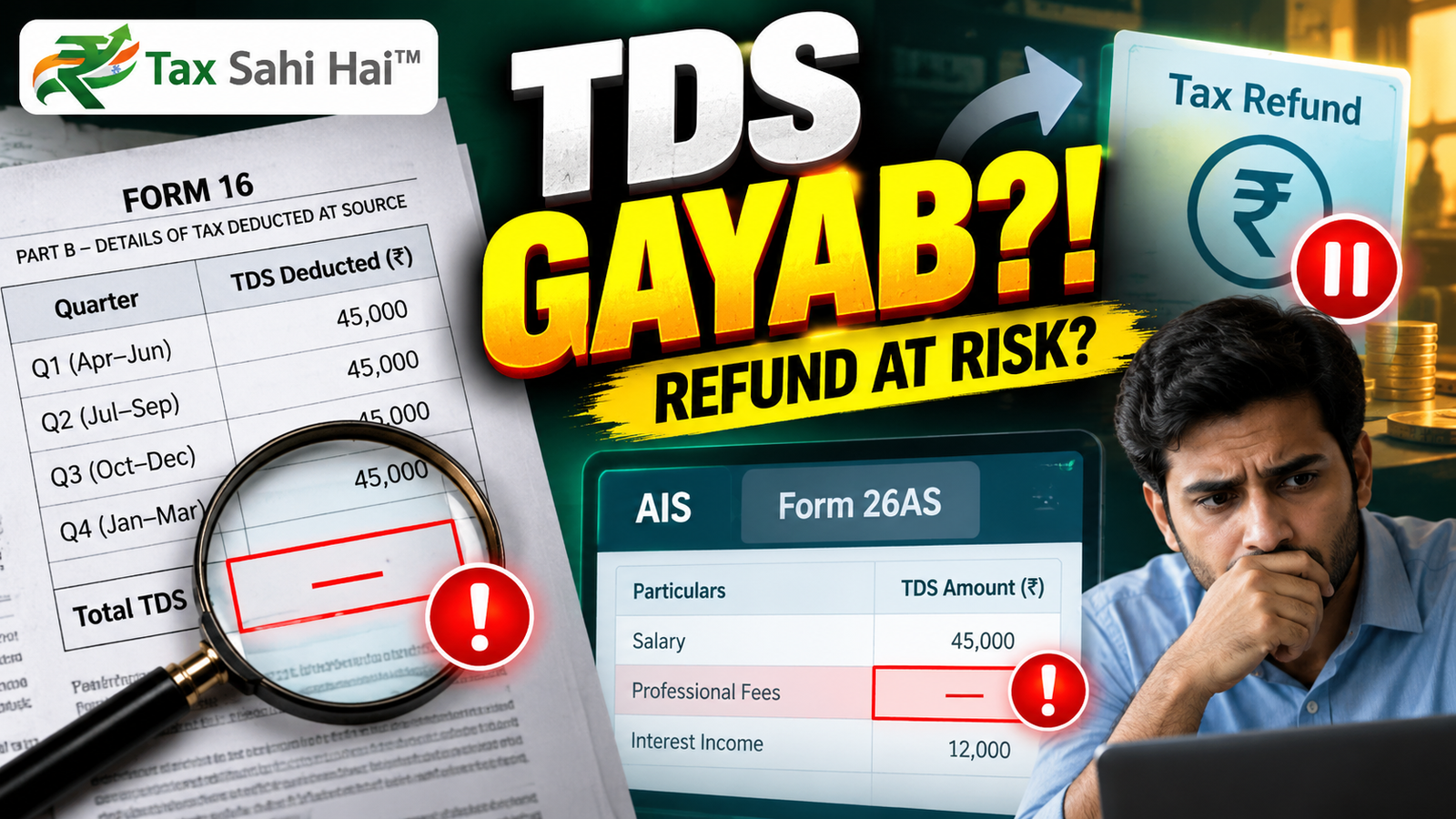
You check your payslip, see the TDS column, feel reassured, and move on. Then one evening before filing season you open Form 26AS to pre-fill your return and that exact amount simply isn't there. No error message, no explanation — just a number that should exist and doesn't. It's one of the more unsettling moments in Indian tax filing, because the money left your hands months ago but the system has no record of it.
"TDS being deducted and TDS being credited to you are two different events, separated by paperwork someone else is responsible for filing."
Who's responsible for what, exactly
Every TDS deduction involves two parties with very different jobs. The deductor — your employer, a client, a bank — withholds a portion of your payment and is legally obligated to deposit it with the government within a set timeline. You, the deductee, have no control over whether that deposit happens on time, or at all. This asymmetry is the root of almost every missing-TDS complaint.
It's worth separating the two failure points clearly before assuming the worst: a deductor who deposits late is a compliance headache for them; a deductor who never deposits is a different problem entirely, and one you'd want to know about early rather than discovering at refund time. This same asymmetry is behind a broader pattern of TDS losses that salaried employees also run into, just with a single deductor instead of several.
How TDS is supposed to travel to your records
The full journey has four steps, and your Form 26AS entry is the last one, not the first. First, the deductor withholds tax at the time of payment — your salary credit, your freelance invoice settlement, your bank interest payout. Second, that amount is deposited with the government, usually by the 7th of the following month. Third — and this is the step people forget exists — the deductor files a TDS return, Form 24Q for salaries or Form 26Q for most other payments, on a quarterly basis. Only after that return is filed does the amount show up against your PAN.
Why the return-filing step matters more than the deposit
A lot of people assume that once the deductor has "paid" the TDS to the government, it should appear in their account automatically. It doesn't. The deposit and the return are two separate filings, and the government's system only attributes the credit to your PAN once the quarterly return names you specifically. A deductor who deposits on time but files their return late creates exactly the gap you're trying to diagnose. The underlying filing mechanics are set out in CBDT circulars issued whenever the TDS return format or deadlines are revised.
The four reasons TDS goes missing
Return not filed yet
The deductor deposited the tax but hasn't filed the quarterly TDS return, so your PAN hasn't been matched to the deduction.
Wrong PAN quoted
A single digit entered wrong in the deductor's filing sends your credit to someone else's account instead of yours.
Quarter-end timing lag
Deductors often file close to the statutory deadline, so a deduction from early in the quarter can sit unreported for weeks before it appears.
Deposit never made
The rarer but more serious case — the deductor withheld the amount from your payment but never actually deposited it with the government.
A missing entry in isolation rarely tells you which of these four it is. You need to compare dates and amounts carefully before concluding anything, which is exactly what the next section walks through.
Confirming the gap before you panic
Start with your own paper trail. Pull your Form 16 or Form 16A — whichever the deductor issued — and note the exact TDS amount and the quarter it relates to. Then open your Form 26AS and your AIS side by side and search for that quarter. It's entirely possible the entry is missing from Form 26AS but present in AIS, or the reverse, since the two don't always refresh on identical cycles.
For a more granular reconciliation, the TRACES portal lets you pull a TDS statement status view that shows whether a particular deductor's quarterly return has even been filed yet, which is a faster way to know if you're simply early rather than genuinely stuck. This kind of systematic cross-check is the same habit worth building for AIS tracking generally, not just for TDS gaps.
Step one: go back to the deductor
This sounds obvious, but it's the step most people skip because it feels awkward — especially with a client rather than an employer. Send a direct, specific message: the amount deducted, the date, the invoice or payslip reference, and a request to confirm which quarter's return it will appear in. A deductor who deducted in good faith usually responds quickly, because an unresolved TDS mismatch is a compliance risk for them too, not just an inconvenience for you.
If the deductor quoted your PAN incorrectly, this conversation is also where that surfaces — they'll need to check their own filing records to spot it, since the error won't be visible to you from outside.
Step two: wait out the filing cycle, deliberately
If the deductor confirms the deduction is genuine and simply hasn't been filed yet, the honest answer is often to wait — but wait with a specific date in mind, not indefinitely. Quarterly TDS returns have statutory due dates, and most deductors file close to them rather than immediately after deducting. Mark the due date for that quarter, add a few weeks for processing, and check again rather than checking daily out of anxiety.
A deduction from April showing up only in late July isn't unusual — it's simply how the quarterly cycle works. Treat the first few weeks after a deduction as normal lag, not a red flag.
Step three: escalate when the deductor goes quiet
Not every deductor responds. Freelance clients sometimes disappear, small employers sometimes fold, and occasionally you're simply ignored. If you've waited through a reasonable filing cycle and heard nothing, you can raise a formal grievance through the income tax department's e-filing portal, attaching your proof of deduction. This isn't an aggressive step — it's the documented route for exactly this situation, and it puts a paper trail on record that protects you later.
The income tax e-filing portal is where both AIS access and grievance submission live, so it's worth getting familiar with the interface before you actually need it under time pressure.
- 01
Confirm the gap by comparing Form 16/16A against 26AS and AIS
- 02
Contact the deductor directly with specific amount and date proof
- 03
Wait out the relevant quarter's filing cycle before escalating
- 04
Raise a formal grievance if the deductor stays unresponsive
What if it's still missing when you file your return
Filing deadlines don't pause for an unresolved TDS mismatch. If the entry still isn't reflecting when you're ready to file, you have a genuine decision to make: file without claiming that credit and amend later, or claim it anyway on the strength of your documentation. Each path carries a different risk, and neither is automatically wrong — it depends on how strong your proof is and how much the amount matters to your refund.
Claiming credit the system hasn't matched yet
You're allowed to claim TDS credit even if it isn't showing in Form 26AS, provided you can substantiate it. The department's processing system will flag the mismatch and typically hold your refund until it's resolved or reconciled, which is slower than a clean match but not a dead end. If the deductor files their return shortly after, the gap often closes on its own during processing. Running the numbers through our tax calculator beforehand at least tells you how much of your refund is actually riding on this one entry.
If this turns into something that needs a formal fix after your return is already in, the department's own mismatch resolution process covers which correction route actually applies to a post-filing TDS gap — and if the credit surfaces only after you've already filed, understanding the difference between a revised return and a rectification request saves you from picking the wrong fix.
The real risk of over-claiming without proof
Claiming a TDS credit you can't substantiate — or worse, inflating an estimate because you're "sure" the client deducted at the usual rate — is a different category of problem from a genuine timing gap. The department reconciles claimed credit against filed returns eventually, and an unsupported claim results in a tax notice with interest, not just a processing delay. The safer default is always to claim exactly what you can document, even if that means a smaller refund this cycle.
Never round up or estimate a TDS figure because you expect the deductor deducted "the usual amount." Claim only what your Form 16A or bank credit record actually supports.
Why freelancers and consultants feel this more often
A salaried employee has exactly one deductor relationship to monitor. A freelancer billing four or five clients under Section 194J is running four or five parallel TDS trails, each dependent on a different client's internal compliance habits. One client files diligently every quarter; another treats it as an afterthought. The result is that freelancers routinely see partial Form 26AS pictures — some clients' deductions present, others missing — well into the financial year.
This is also where the gap compounds with cash-flow pressure, since freelancers are already managing irregular income. For the broader pattern of where TDS commonly leaks value for working professionals generally, it's a habit worth building regardless of employment type, and our dedicated freelancer ITR guide covers the filing-side mechanics in more depth.
The official provisions governing how TDS under Section 194J operates — rates, thresholds, and deductor obligations — are laid out on the Income Tax India reference site, which is useful when a client disputes whether they should have deducted at all.
Documents worth keeping as proof, always
- Form 16 or Form 16A issued by the deductor for the relevant period.
- Bank statement entries showing the net (post-TDS) amount credited.
- The original invoice or contract specifying the gross amount and applicable TDS rate.
- Any written communication from the deductor confirming the deduction and timeline.
- A dated screenshot or export of Form 26AS/AIS at the time you noticed the gap.
Keep these in one folder per client or employer rather than scattered across email threads — it makes both the escalation conversation and any eventual grievance filing far faster to put together. A missing credit is also a good prompt to review your broader tax savings position, since an unresolved TDS gap often sits alongside other deductions nobody has double-checked recently.
A quick note on the Protean/NSDL side of things
Form 26AS generation itself is handled through infrastructure maintained by Protean (formerly NSDL), which processes the TDS statements deductors file before they reach your account view. If a deductor insists they've filed correctly but your Form 26AS still doesn't reflect it after a reasonable window, this is the layer where processing delays — as distinct from deductor errors — occasionally originate.
How Tax Sahi Hai Can Help
A missing TDS entry is rarely complicated to fix once someone maps out exactly where in the four-step chain it broke down — the hard part is usually figuring out which step, and what to do about it without losing weeks.
| What You Need | How We Help | Link |
|---|---|---|
| Reconcile Form 16/16A against 26AS and AIS | A line-by-line check across every deductor to spot exactly where credit is missing or mismatched. | Compliance correction |
| Respond to a mismatch notice from the department | Draft and file the right response with your supporting proof so processing isn't held up longer than necessary. | Notice resolution |
| Decide whether to claim unmatched credit or wait | A practical read on your specific documentation strength before you commit to either path at filing time. | Expert advisory |
Frequently asked questions
Why is TDS deducted from my payment not showing in Form 26AS?
Most commonly, the deductor hasn't filed their TDS return (Form 24Q or 26Q) for that quarter yet. TDS reflects in your Form 26AS and AIS only after the deductor files the return, not the moment they deduct or deposit the amount.
Is there a difference between AIS and Form 26AS for TDS entries?
Both pull from the same underlying TDS statements, but AIS sometimes updates on a slightly different cycle and also shows additional information categories. If an entry is missing from one, check the other before assuming it's a deductor-side problem.
My client deducted TDS on my freelance invoice but it's not showing anywhere. What now?
Ask the client for the TDS certificate (Form 16A) and the quarter they intend to file the return in. Many clients deduct monthly but file the TDS return only once at quarter-end, so a short lag is normal before you escalate.
Can I still claim TDS credit in my ITR if it's not in Form 26AS?
You can claim it only if you have strong proof — a Form 16A, bank statement showing the net payment, and ideally written confirmation from the deductor. Claiming unmatched credit without proof invites a notice and possible demand.
What happens if the deductor quoted the wrong PAN while filing?
The deduction gets credited to whoever's PAN was actually entered, not yours, even though the money was deducted from your payment. You'll need the deductor to file a correction statement to move the credit to the right PAN.
How long should I wait before escalating a missing TDS entry?
Give it until roughly a month after the quarterly filing due date, since deductors often file close to the deadline. If it's still missing after that window and the deductor isn't responding, it's reasonable to raise things through TRACES or a formal grievance.
Are freelancers and consultants more exposed to this problem?
Yes. Someone with a single employer has one TDS relationship to track. A freelancer invoicing five clients under Section 194J is tracking five separate TDS trails, and any one of them can go missing without much visibility until return-filing time.
Will a missing TDS entry delay my refund?
It can. If you claim credit that doesn't match the department's records, the return often gets flagged for processing delay or a mismatch notice, which takes longer to resolve than simply waiting for the entry to appear correctly.
Don't let a missing credit become a missed refund
A quick reconciliation now is far easier than untangling a mismatch notice after you've already filed.
Talk to Tax Sahi Hai and get your TDS trail checked before filing season closes in on you.