GST Notice Received? Common Reasons Businesses Get Notices and What to Check First
GSTR mismatches, ITC reversals, e-way bill errors — most GST notices trace back to a handful of common triggers. Here is what to check first before you respond.
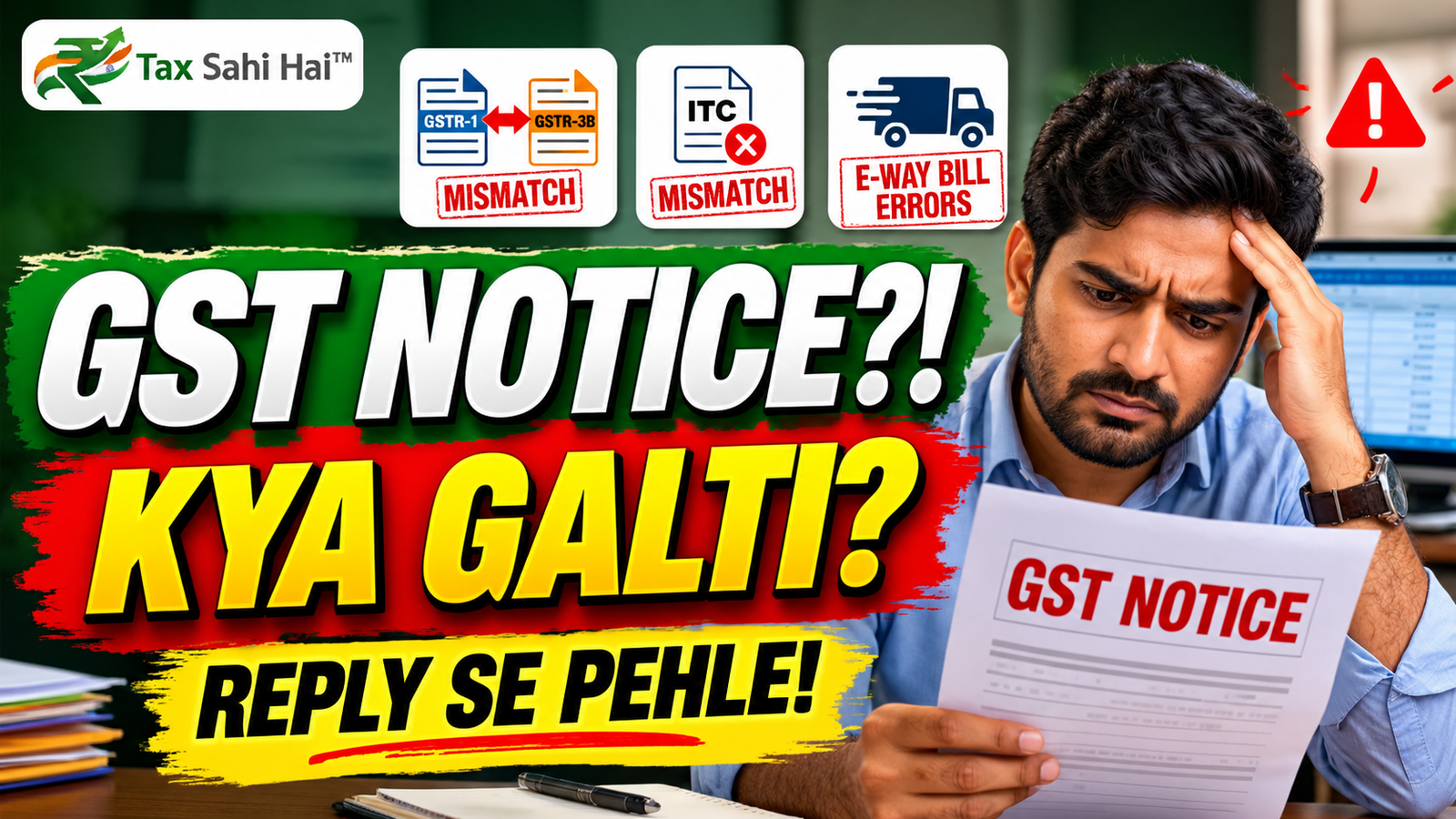
The GSTIN login notification lands on a Tuesday afternoon, usually while you're in the middle of something else, and your stomach drops before you've even opened it. Most GST notices aren't the disaster they feel like in that first minute. Most of them are routine, explainable, and fixable — but only if you read the notice correctly and respond on time instead of letting panic or avoidance take over.
"A GST notice is a question, not a verdict. The businesses that get hurt are the ones that treat it as the second thing instead of the first."
Why GST notices have become so routine
GST return filing was built from day one to be matched automatically — your GSTR-1 against your buyer's GSTR-2B, your GSTR-3B against your GSTR-1, your e-way bills against your invoices. That automation is exactly why notices have become so common for small and mid-sized businesses. The system doesn't need a human officer to spot a mismatch anymore; software flags it, and a notice gets generated. None of this means your business did something dishonest. It usually means two numbers that should match, don't.
The volume of these system-generated queries has grown steadily as GSTN's data matching has matured, and that trend isn't reversing. If anything, expect more automated scrutiny, not less, as the department leans further into return-matching rather than manual audits. If you've landed here from our broader GST notice overview, this piece goes deeper into the specific triggers.
The usual suspects: what actually triggers a notice
Across the businesses we see, the same handful of causes show up again and again.
GSTR-1 vs GSTR-3B mismatch
You report different outward supply figures in your invoice-level return versus your summary return. Even a rounding difference carried across months adds up to something that looks deliberate.
ITC claimed but vendor didn't file
You claimed input tax credit based on an invoice, but your vendor never uploaded that invoice in their GSTR-1, or filed late. Your GSTR-2B simply doesn't show it.
E-way bill discrepancies
Goods moved without a valid e-way bill, or the e-way bill value doesn't match the invoice value, or the vehicle details were never updated for a transshipment.
Turnover mismatch with income tax
Your GSTR-3B turnover for the year doesn't line up with the revenue reported in your income tax return or reflected in Form 26AS, and nobody reconciled the difference before filing either one.
A less obvious trigger worth naming separately: non-filing for consecutive tax periods. Miss two or three return cycles in a row, even for a dormant business you intend to revive, and the system flags you well before you get around to catching up. Turnover mismatches specifically get picked up because the department cross-checks figures against the income tax records you've separately filed.
The notice types you'll actually encounter
GST notices come with form numbers that sound intimidating but mostly follow a predictable escalation.
ASMT-10: the opening question
This is a scrutiny notice. The officer has spotted a discrepancy — commonly a return mismatch — and is asking you to explain it or pay the difference voluntarily. It is not a final demand. Responding well here often ends the matter entirely.
DRC-01: the formal demand
This follows when the department believes there's a genuine short-payment or wrongly claimed credit, usually after an unsatisfactory ASMT-10 response or a direct audit finding. It's a show-cause notice proposing tax, interest and penalty, and it requires a structured written reply — the same category of formal demand notice that applies on the income tax side once an assessment is finalised.
REG-17: registration under threat
This proposes cancelling your GST registration, typically triggered by continuous non-filing or a flagged compliance pattern. It deserves immediate attention because an unanswered REG-17 can actually result in cancellation, which then disrupts your ability to issue valid invoices. The underlying return-matching infrastructure behind all three notice types is run by GSTN, which is worth knowing simply to understand why these mismatches get caught so consistently now.
Notice numbers aren't a ranking of how serious your situation is — they describe the stage of the process. An ASMT-10 handled badly can escalate into a DRC-01. A DRC-01 handled well can still close without any real penalty.
What to check first, before you do anything else
The instinct is to either panic-call your accountant or ignore the notice for a week. Neither helps. Here's the sequence that actually matters.
- 01
Verify the notice is genuine on the GST portal under 'View Notices and Orders', checking the DIN
- 02
Identify the exact GSTIN and tax period the notice refers to — not the date you received it
- 03
Pull your GSTR-2B for that period and reconcile it line by line against your purchase register
- 04
Note the response deadline printed on the notice and work backward from it, not forward from today
That third step is where most of the real answer usually lives. A surprising number of "ITC mismatch" notices resolve themselves once you actually sit down and compare GSTR-2B against your books, because the gap is often a timing difference rather than a genuine loss. You can pull both documents directly from the GST portal once you're logged in.
System-generated query versus genuine scrutiny
Not every notice carries the same weight. A system-generated query is auto-triggered purely by a data mismatch and often gets resolved by filing a clarification or an amended return. A scrutiny notice issued by an actual officer after reviewing your filings carries more judgment behind it, and a templated response won't satisfy it. Telling the two apart early saves you from either over-reacting to a routine mismatch or under-reacting to something that needed real documentation.
A notice with no officer name, no specific line-item reference and generic wording is almost always system-generated. One quoting specific invoice numbers or comparing two years of data was prepared by a person — treat it accordingly.
How vendor non-compliance quietly costs you ITC
This is the one that frustrates business owners the most, and understandably so. You pay your vendor the full invoice amount including GST. Your vendor is supposed to deposit that GST and file their return showing the sale. If they delay, under-report, or simply stop filing, your GSTR-2B won't reflect that invoice — and the credit you claimed can get disallowed, leaving you to pay it again from your own pocket while chasing the vendor separately for recovery.
There's no clean fix for this beyond discipline: check your GSTR-2B before claiming credit each period, not after, and be selective about which vendors you extend open credit terms to if their filing history is inconsistent. Our compliance checklist covers the habit of monthly reconciliation that catches this early, before it compounds across several tax periods.
Common mistakes small businesses make when a notice arrives
- Assuming an email notice is a scam and ignoring a genuine one until the deadline passes.
- Replying with a verbal or informal explanation instead of filing the structured response the portal requires.
- Paying the proposed demand immediately just to "make it go away," without checking if the underlying figure is even correct.
- Treating the notice as the accountant's problem alone, without pulling the underlying invoices and bank records in-house.
- Not checking whether the same issue affects other tax periods that haven't been flagged yet.
That last point matters more than it sounds. If one quarter shows a GSTR-1 vs GSTR-3B gap, there's a decent chance the same reporting error exists in adjacent quarters too, and it's cheaper to fix it proactively than to wait for a second notice.
Documents to keep ready before you even open the reply form
Responding quickly and well depends entirely on whether your records are already organised. Keep these on hand as a standing habit, not a scramble:
- GSTR-1, GSTR-3B and GSTR-2B for the relevant and surrounding tax periods.
- Purchase register and sales register reconciled against the returns filed.
- Copies of e-way bills for the periods under question, with vehicle and transporter details.
- Vendor invoices and proof of payment, including GST component paid separately where relevant.
- Bank statements covering the period, in case turnover reconciliation is questioned.
Response windows and what's typical
These figures are illustrative, not fixed by law for every notice type — the deadline printed on your specific notice always governs. Treat the numbers above as a sense of typical pacing, not a substitute for reading your own document carefully. For the authoritative reference on notice types, timelines and procedural rules, the CBIC website publishes the relevant circulars.
When the notice ties back to e-invoicing or e-way bill systems
If your discrepancy involves invoice value versus e-way bill value, or a missing IRN on an invoice that should have carried one, check the records on the e-invoice portal directly rather than relying on your accounting software's export, since the two occasionally drift out of sync after a software update or a manual invoice edit.
This category of notice often overlaps with what triggers a bank freeze in more serious cases, which is exactly why e-way bill accuracy deserves more attention than most businesses give it day to day.
When to stop handling it yourself and bring in a professional
A clerical clarification — an obvious rounding error, a late filing you've since corrected — is reasonable to answer on your own through the portal. Once a notice proposes an actual demand, questions multiple tax periods together, or threatens registration cancellation, the written response becomes part of a formal record that can be used against you later if it's vague or incomplete. That's also the point where a routine query can tip into actual scrutiny, which deserves a more careful, professionally reviewed reply — the same caution applies when a GST issue surfaces alongside a parallel tax audit on the income tax side.
Never let a response deadline pass while "waiting to hear back" from someone. An unanswered show-cause notice typically results in an order being passed against you based on the department's own assessment, with far fewer options to contest it afterward.
Building a habit that prevents the next notice
The businesses that stop getting repeat notices usually make one structural change: monthly reconciliation becomes non-negotiable, not something done at year-end. It also helps to run your numbers through our tax calculator periodically, since a turnover figure that looks fine in isolation can still drift out of sync with what you eventually report at year-end. For growing businesses, it's also worth revisiting whether your business structure still matches your compliance capacity.
A ten-minute GSTR-2B versus purchase register check at the start of each filing cycle catches most ITC-related notices before they're ever issued. It's a small habit with an outsized payoff.
How Tax Sahi Hai Can Help
Getting a notice right the first time is almost always cheaper and less stressful than fixing a bad response later.
| What You Need | How We Help | Link |
|---|---|---|
| Understand and respond to a GST notice correctly | We review the exact notice, identify the real issue, and draft a structured reply before your deadline. | Notice resolution |
| Fix the underlying mismatch so it doesn't recur | We reconcile your GSTR-1, GSTR-3B and GSTR-2B and correct recurring reporting gaps. | Compliance correction |
| Decide whether to escalate or settle a demand | A practical read on whether to contest, pay, or negotiate based on your specific facts. | Expert advisory |
Frequently asked questions
I received a GST notice by email. How do I know it's genuine?
Every real GST notice carries a Document Identification Number (DIN) and is also visible under your login on the GST portal, inside the 'View Notices and Orders' section. If an email or SMS pressures you to pay immediately through a link without any DIN, treat it as suspicious and verify through the portal directly rather than clicking anything.
What's the difference between ASMT-10 and DRC-01?
ASMT-10 is a scrutiny notice pointing out discrepancies in your returns and asking for an explanation — it's usually the first step, not a demand. DRC-01 is a formal show-cause notice proposing an actual tax, interest or penalty demand, issued when the department believes there's a confirmed short-payment or wrong ITC claim.
Can I lose Input Tax Credit even if I paid my vendor in full, including GST?
Yes, and this surprises a lot of business owners. If your vendor collected GST from you but never filed their GSTR-1 or GSTR-3B, that credit may not reflect in your GSTR-2B, and the department can ask you to reverse it — regardless of whether you paid the vendor correctly.
How long do I have to respond to a GST notice?
It varies by notice type, but most scrutiny and show-cause notices give somewhere between 7 and 30 days. The exact deadline is printed on the notice itself — never assume a standard window, and never let the date pass while you're still 'figuring out what it means'.
Will a GST notice automatically freeze my bank account?
Not on its own. A routine scrutiny or mismatch notice doesn't trigger a freeze. Recovery action, including provisional attachment of a bank account, typically follows only after a confirmed demand remains unpaid past its deadline, or in specific cases of suspected fraud.
What if the notice is about a period where my accountant has since left?
The GSTIN and tax period are yours regardless of who filed the return. Gather whatever records exist — bank statements, invoices, e-way bills — and reconstruct the position. A gap in record-keeping handover is common but doesn't change your obligation to respond.
Can a small turnover mismatch between my GST returns and income tax return trigger a notice?
Yes. The department increasingly cross-checks turnover reported in GSTR-3B against figures in your income tax return and Form 26AS. A consistent gap, even an honest one caused by different reporting periods, is enough to trigger an automated query.
Should I respond to a GST notice myself or hire a professional?
Simple clerical notices with an obvious explanation can often be answered yourself through the portal. Anything involving a demand, ITC reversal, or registration cancellation proposal is worth routing through a professional, since the written response becomes part of your compliance record.
Don't let a GST notice sit unanswered
Most notices are fixable within the deadline if you respond with the right facts, the first time.
Talk to Tax Sahi Hai and get help reading your notice correctly before you reply.